How Much Does It Cost to Fumigate a House?
Quick answer
$1,500–$8,000 · avg $4,500
Whole-house fumigation costs $1,500–$8,000, and the average tented job lands near $4,500. The rate depends on the pest: termite gas runs $1–$4 per square foot, bed bug fumigation $4–$8 — which is why the same house can get quotes thousands of dollars apart.
| Treatment | Typical range | Average | Notes |
|---|---|---|---|
| Whole-house fumigation | $1,500–$8,000 | $4,500 | $1–$4/sq ft termites; $4–$8/sq ft bed bugs |
| Home size | Typical range | Average |
|---|---|---|
| Apartment / under 1,000 sq ft | $1,200–$6,400 | $3,600 |
| 1,000–2,000 sq ft | $1,500–$8,000 | $4,500 |
| 2,000–3,000 sq ft | $1,800–$9,600 | $5,400 |
| Over 3,000 sq ft | $2,100–$11,200 | $6,300 |
What fumigation is — and what it is not
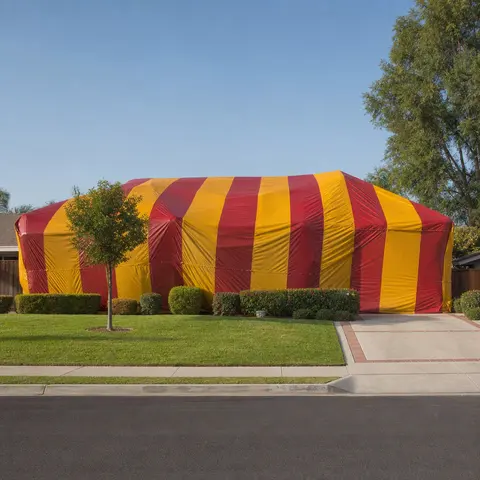
Fumigation is the only pest treatment that reaches every cubic inch of a structure. The crew seals the building under tarps, releases sulfuryl fluoride gas, and for roughly a day the gas penetrates wall voids, attic framing, furniture, subfloors — anywhere air goes. No drill hole, bait station or spray rig matches that reach, which is why tenting is the standard fix for drywood termites living in framing you cannot open up.
Here is the part the sales pitch skips: the gas leaves zero residual protection. Once the tent comes off and the house aerates, there is no barrier, no bait, nothing working on your behalf. A new termite swarm can land on the eaves the same week; a bed bug can ride home in a suitcase the day you move back in. Fumigation is a reset button, not a shield — and that makes it the wrong tool entirely for subterranean termites, whose colony lives in the soil outside the tent. Those jobs call for a liquid barrier ($500–$2,000 for a whole home) or a bait system ($1,000–$2,500), both of which keep working after the crew leaves. Our termite exterminator cost guide breaks down when each applies.
The per-square-foot math
National guides put whole-house fumigation at $1,500–$8,000 — the band published across the Angi and HomeAdvisor family of 2026 guides — with the average job near $4,500. Bob Vila lands almost exactly there: a $4,750 average on the same $1,500–$8,000 spread. The wide band is not noise. It is two different jobs priced at two different rates, and the target pest decides which one you are buying:
| Target pest | Published rate | 2,000 sq ft home | Source |
|---|---|---|---|
| Drywood termites | $1–$4 per sq ft | $2,000–$8,000 | HomeGuide, November 2025 termite guide |
| Bed bugs | $4–$8 per sq ft | $8,000–$16,000 | HomeGuide and HomeAdvisor bed bug guides |
| Roaches, severe | $1–$4 per sq ft | $2,000–$8,000 | HomeAdvisor, June 2026 |
Run your own footage through the rate before anyone quotes you. A 1,500 sq ft bungalow with drywood termites should see numbers between $1,500 and $6,000; if the quote comes back near $8,000, you are being charged bed-bug concentration for a termite job. In practice most termite tents land in the lower half of the band — Fixr tracked completed drywood fumigations at $1,570–$2,857 as of its January 2025 guide, and HomeAdvisor pegs real roach tenting jobs at $2,500–$7,500. Bed bug fumigation is the genuine budget-breaker: the gas concentration and exposure time needed to kill eggs push it to $4–$8 per square foot, $4,000–$16,000 for a whole house per HomeGuide, and HomeAdvisor notes large buildings can clear $50,000.
Two to three days out — and the costs that are not in the quote
Treat a fumigation like a short move-out, because that is what it is. Day one the crew tents the house and releases the gas; day two the gas does its work; day three the crew aerates, tests the air with instruments, and signs a clearance certificate that legally lets you back in. Everyone leaves — people, pets, and houseplants — and anything you will eat or swallow gets double-bagged in the sealed bags the fumigator supplies, or removed entirely. Budget an evening for the bagging alone; a full pantry takes longer than most homeowners expect.
Two logistics items decide whether the job takes three days or five. First, the gas utility: service must be shut off before the tent goes up and relit after clearance, and the utility comes on its own schedule — book both visits the day you sign the contract. Second, access: the tent goes over fences and against landscaping, so vegetation tight against the walls may need cutting back before the crew arrives. The tent is locked with secondary locks, but a tented house still advertises that nobody is home — move small valuables out with the medicine.
Then there is the line item no contract shows: lodging. Two to three nights near your own home, plus eating out, sits entirely on you. Price it locally and add it to the quote before comparing fumigation against alternatives that let you sleep in your bed. The one cost you can cross off is cleanup — the gas dissipates completely instead of settling on surfaces, which is exactly why it also protects nothing going forward.
When tenting is genuinely required — and when a spot treatment does it
For drywood termites, the honest test is geography inside the house. Pellets and kickout holes in one window frame is a mapped, local problem: a spot treatment runs $225–$1,000, average $575, an order of magnitude below the tent. Evidence in multiple rooms, or galleries in framing nobody can reach without demolition, is what fumigation was invented for — no injection rig finds every gallery in a hidden ridge beam. A middle option exists for chemical-averse owners: heat tenting at $1–$3 per square foot, $2,000–$6,000, cooks the same drywood colonies without gas.
For bed bugs, fumigation is the last resort by price alone. A whole-home chemical program runs $1,000–$5,000 (average $2,500, over 2–3 visits), heat treatment $2,000–$6,000 in a single day, and a single infested room $300–$650. The $4–$8 per square foot tent is rational only after a properly executed heat or chemical round has failed, or in structures too cluttered or too leaky to heat evenly. Anyone quoting structural fumigation as the first response to bed bugs in one bedroom is selling the most expensive item on the menu first.
For roaches, tenting at $2,500–$7,500 exists for true structure-wide failures — usually severe German roach infestations that outlasted repeated baiting. Almost every residential case resolves for $100–$600 (average $300) with a gel bait program, and because roaches reinvade from drains and adjoining units the day the tent comes off, gas without a follow-up plan is the weakest money you can spend on them.
What real companies charge — our Florida check
Florida is the most fumigation-heavy market in the country thanks to drywood termite pressure, so we checked the published numbers there directly. In our survey of 588 Florida pest-company websites (July 2026), one Miami firm published a confirmed tenting range of $1,500–$4,000, and three more publish market-range claims of $1,200–$4,500, $1,400–$3,800, and $1,500–$5,000 — four independent numbers that agree with each other. The takeaway: in the state that tents the most houses, real termite fumigation sits in the lower half of the national $1,500–$8,000 band. Quotes pressing $8,000 belong to large or hard-to-seal structures, or to bed-bug-rate work — not to an ordinary single-family termite job.
The same survey explains the free-inspection red flag above: 205 of the 588 companies advertise free inspections. The inspection is a sales channel, and national data prices an independent termite inspection at only $0–$150 (average $100) — cheap insurance before signing a four-figure tenting contract on one company’s say-so. How we collect and weigh both the national guides and our own survey data is documented on our methodology page.
The decision fits in one line: tent when the whole structure is confirmed infested, spot-treat when the problem is mapped and local, and never buy gas as prevention — it prevents nothing.
Whole-house fumigation Cost Calculator
Pick your pest and home details — the estimate updates instantly. Same data as the tables on this site.
Your estimated cost
$1,500–$8,000 · avg $4,500
$1–$4/sq ft termites; $4–$8/sq ft bed bugs
- Tenting of the full structure
- 2–3 days out of the home (incl. pets/plants)
- Gas monitoring and clearance certificate
- Food/medicine bagging materials
- Re-entry safety inspection
Estimate for budgeting, not a quote — final pricing always follows an inspection.
Whole-house fumigation cost by state
Prices below are our national range adjusted with state labor (BLS) and price-level (BEA) data — see how we calculate. Full state guides: all 50 states.
| State | Typical range | vs national |
|---|---|---|
| California | $1,650–$8,750 | + 10% |
| Texas | $1,400–$7,450 | -7% |
| Florida | $1,500–$8,100 | + 1% |
| New York | $1,650–$8,950 | + 12% |
| Pennsylvania | $1,450–$7,850 | -2% |
| Illinois | $1,500–$8,100 | + 1% |
| Ohio | $1,400–$7,500 | -6% |
| Georgia | $1,400–$7,550 | -6% |
| North Carolina | $1,450–$7,700 | -4% |
| Michigan | $1,500–$7,900 | -1% |