How Much Does a Roach Exterminator Cost?
Quick answer
$100–$600 · avg $225
A professional roach treatment runs $100–$600, and most jobs land at $200–$250. German cockroaches need a gel bait program with a follow-up visit; American (palmetto) roaches are a cheaper one-visit perimeter job, and fumigation ($1,000–$3,000) is a rare last resort.
| Treatment | Typical range | Average | Notes |
|---|---|---|---|
| Standard treatment | $100–$600 | $225 | — |
| Gel bait program | $100–$600 | $300 | — |
| Roach fumigation | $1,000–$3,000 | $2,000 | $1–$4 per sq ft |
| Tenting (severe) | $2,500–$7,500 | $5,000 | — |
| Home size | Typical range | Average |
|---|---|---|
| Apartment / under 1,000 sq ft | $80–$475 | $180 |
| 1,000–2,000 sq ft | $100–$600 | $225 |
| 2,000–3,000 sq ft | $120–$725 | $275 |
| Over 3,000 sq ft | $140–$850 | $325 |
Species decides the bill — get the ID first
Roach pricing looks like one number — $100–$600 across HomeAdvisor’s June 2026 roach guide, Angi’s March 2026 data and HomeGuide’s January 2026 guide — but where you land in that band is decided almost entirely by which roach you have. Real completed jobs on Thumbtack ran $112–$271 as of April 2026, and Forbes notes most jobs price near $250, which is why we call $200–$250 the honest middle and treat $600 as the severe end, not the norm.
German cockroaches are the expensive case. They are small, live entirely indoors, breed in kitchen and bathroom voids, and a female can produce an egg case holding 30–40 nymphs. They cannot be sprayed away from a perimeter — the job is an indoor gel bait program with a mandatory follow-up, and it fills the middle and upper half of the $100–$600 band.
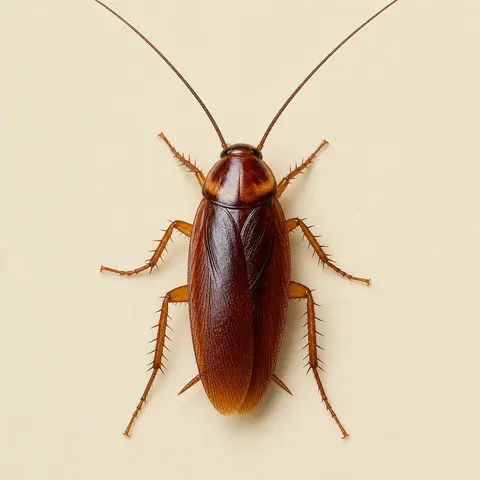
American roaches — the palmetto bugs of the Gulf states — are the opposite problem. They are big, alarming, and mostly live outdoors in sewers, mulch and palm litter, wandering inside through gaps. The fix is an exterior perimeter treatment plus entry-point work, usually one visit, priced at the low half of the band. Oriental roaches in damp basements and drains get similar one-visit scope.
This is why a phone quote without a species ID is fiction. A company that quotes a firm price before knowing whether you have German roaches or palmetto visitors is quoting a marketing number, not a treatment plan. Insist on identification in writing — every legitimate roach protocol starts there.
What a real German roach program includes
The professional standard for German roaches is gel bait plus an insect growth regulator (IGR). Bait placements go where roaches actually live — hinge voids, under and behind appliances, cabinet corners, plumbing penetrations — and the roaches carry the toxicant back to harborage, killing the ones that never cross a sprayed baseboard. The IGR is the population killer: it stops nymphs from maturing, so the colony collapses instead of rebounding. HomeAdvisor prices a gel bait program at $100–$600, the same band as the standard visit, because for German roaches the bait program is the standard visit.
Then comes the follow-up, 2–4 weeks later. Gel bait does not penetrate egg cases, so a wave of nymphs hatches after the first visit no matter how good the technician is. The second visit re-baits for that generation. A one-and-done German quote is not a smaller job — it is half a job.
The failure mode to avoid is the baseboard-spray-only quote. HomeAdvisor prices a simple insecticide spray at $40–$100 per treatment, and that number is the tell: spray is the cheap line item, not the program. Repellent sprays scatter German roaches deeper into wall voids, can contaminate bait placements so roaches stop feeding on them, and do nothing to the egg cases. If a company plans to charge you a mid-band program price for what is functionally a $40–$100 spray pass, you are paying for eradication and buying a knockdown.
Size and severity: the honest spread
Roach jobs scale with home size more gently than general pest work at the small end. HomeAdvisor’s roach-specific size table starts at $100–$150 for a 1,000 sq ft home and climbs to $450–$550 at 3,000 sq ft — more territory means more bait placements, more monitors and more technician time. The size and severity tables above apply those multipliers to the national figures.
Severity is the other axis, and it is where the scary headline numbers live. HomeAdvisor notes severe cases running as high as $7,500 and Forbes stretches its range to $8,000 — but that tail is whole-structure tenting, not a typical ticket. A moderate German infestation in an average kitchen is a $200–$250 program; it becomes a four-figure project only when the population has spread structure-wide or the building itself works against treatment.
The apartment problem: your unit is not the unit
German roaches travel plumbing chases, shared walls and utility penetrations. In a multi-unit building, the infestation is almost never confined to the apartment where the roaches are visible — which is why treating one unit in an infested building buys you a few quiet weeks and then a reinfestation from next door. The industry-standard answer is coordinated treatment of the adjacent units: both sides, above and below, at minimum monitored if not baited.
That raises the question of who pays. In most states an established roach infestation in a rental is a habitability issue, which makes it the landlord’s problem unless the lease specifically shifts it or the tenant demonstrably caused it. Put the report in writing, and push for two things: bait-based treatment (ask what product will be used — if the answer is a monthly hallway spray, that is the cheap vendor failure mode) and inclusion of neighboring units. A single-unit visit prices at the bottom of the $100–$600 band — apartments under 1,000 sq ft sit below the national average in the size table above — but paying even that repeatedly while the building stays infested is the most expensive option of all.
Fumigation and tenting — the rare last resort
Structural fumigation for roaches runs $1,000–$3,000, about $1–$4 per square foot, and full tenting of a severe infestation runs $2,500–$7,500 per HomeAdvisor’s 2026 figures. Those numbers buy a total kill of everything inside the envelope on that day — and nothing after it. Fumigant gas leaves zero residual protection, so a building that backs onto an infested sewer line or sits in an infested complex can begin repopulating as soon as the tent comes off. You are also out of the home for the better part of 2–3 days.
The honest use case is narrow: a structure-wide infestation that a competently executed bait program has already failed to control, or a severe multi-pest situation where the tent is doing double duty — drywood termites plus roaches sharing one bill. If a company leads with fumigation for a kitchen-level German problem, get a second opinion before you get a tent. For what the whole-structure job involves and costs across pests, see our fumigation cost guide.
What companies actually charge: our Florida survey
National bands are one thing; advertised prices are another. In our survey of 588 Florida pest-company websites (July 2026), only a handful publish roach-specific prices at all — and the ones that do cluster tightly. One-time roach treatments ran $125–$250. Staged German deep-eradication programs ran $250–$500, and one Miami company prices its initial visit with follow-up services from $299. That lines up almost exactly with Thumbtack’s $112–$271 range of real completed jobs, and it is the strongest evidence that the $600 top of the national band belongs to severe, multi-visit scope — not to a standard single-family cleanout. How we collect and weigh these numbers is documented in our methodology.
The contract upsell — when a plan is real and when it is a leash
Here is the sales tactic to watch for. German cockroaches are a finite, solvable problem: a gel-bait-plus-IGR program with one follow-up eliminates the population, because German roaches live indoors and cannot re-invade from your yard. A company that answers that call with a 12-month monthly contract is converting a $200–$250 job into $50–$100 per visit forever — HomeAdvisor puts roach plans at $50–$100 per visit monthly or quarterly, with annual service running $200–$1,000. Sold against a one-species German cleanout, that is a leash, not a service.
The legitimate case for recurring service is outdoor pressure. In the Gulf South, American roaches walk in from sewers and landscaping year-round, and no one-time treatment changes what the neighborhood produces — quarterly perimeter service genuinely is the fix, and it usually makes more sense bundled as a general pest control plan at $40–$75 monthly or $100–$300 per quarterly visit than as a roach-only subscription. Florida competition prices this aggressively: general monthly plans in our survey advertise at a median of $39. The decision rule is species, one more time: German infestation — buy the finite program. Palmetto pressure — price the plan.
Roach extermination Cost Calculator
Pick your pest and home details — the estimate updates instantly. Same data as the tables on this site.
Your estimated cost
$100–$600 · avg $225
- Species identification (German vs American matters)
- Gel bait + insect growth regulator
- Crack-and-crevice treatment
- Follow-up visit in 2–4 weeks
- Sanitation and exclusion advice
Estimate for budgeting, not a quote — final pricing always follows an inspection.
Roach extermination cost by state
Prices below are our national range adjusted with state labor (BLS) and price-level (BEA) data — see how we calculate. Full state guides: all 50 states.
| State | Typical range | vs national |
|---|---|---|
| California | $110–$650 | + 10% |
| Texas | $95–$550 | -7% |
| Florida | $100–$600 | + 1% |
| New York | $110–$675 | + 12% |
| Pennsylvania | $100–$600 | -2% |
| Illinois | $100–$600 | + 1% |
| Ohio | $95–$575 | -6% |
| Georgia | $95–$575 | -6% |
| North Carolina | $95–$575 | -4% |
| Michigan | $100–$600 | -1% |