How Much Does a Termite Exterminator Cost?
Quick answer
$500–$2,000 · avg $1,200
Termite treatment runs $225–$1,000 for spot work, $500–$2,000 for a whole-home liquid barrier (average $1,200), and $2,000–$8,000 for tent fumigation. Species decides the method: subterranean termites need soil treatment, drywood termites need wood treatment — priced completely differently.
| Treatment | Typical range | Average | Notes |
|---|---|---|---|
| Spot treatment | $225–$1,000 | $575 | — |
| Liquid barrier (whole home) | $500–$2,000 | $1,200 | $3–$16 per linear ft |
| Bait system (whole home) | $1,000–$2,500 | $1,750 | +$200–$400/yr monitoring |
| Fumigation / tenting | $2,000–$8,000 | $4,500 | $1–$4 per sq ft, drywood termites |
| Termite inspection | $0–$150 | $100 | Often free when bundled with a treatment quote |
| Home size | Typical range | Average |
|---|---|---|
| Apartment / under 1,000 sq ft | $400–$1,600 | $950 |
| 1,000–2,000 sq ft | $500–$2,000 | $1,200 |
| 2,000–3,000 sq ft | $600–$2,400 | $1,450 |
| Over 3,000 sq ft | $700–$2,800 | $1,700 |
The species fork that decides everything
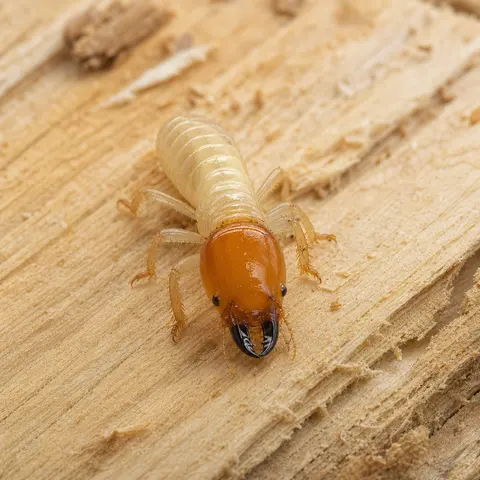
Termite pricing runs from a $225 spot treatment to an $8,000 tent, and the spread is not padding — it is biology. Subterranean termites nest in the soil and commute into your framing through mud tubes; drywood termites live entirely inside the wood, no ground contact at all. Every treatment decision, and nearly all of that price spread, follows from which one you have.
Subterranean termites get soil treatment. The standard job is a liquid barrier: technicians trench around the foundation, drill through slabs and porches where needed, and saturate the soil with termiticide. Both major guides price this per linear foot of perimeter — HomeGuide’s November 2025 termite guide at $3–$20, Fixr’s subterranean figures at $7–$14; call it $3–$16 depending on soil, slab and access — which lands most whole-home jobs at $500–$2,000 with an average near $1,200. The alternative is a bait system: in-ground stations that worker termites carry back to the colony, at $7–$12 per linear foot, or $1,000–$2,500 installed, plus a number the salesperson mentions quietly — $200–$400 a year in mandatory monitoring, indefinitely.
Drywood termites get wood treatment. Localized infestations take a spot treatment — drill-and-inject into the galleries — at $225–$1,000; Forbes’ October 2024 audited guide puts the average termite visit at $575, and HomeGuide prices localized work at $6–$8 per square foot of affected area. Widespread drywood activity means whole-structure fumigation: tenting at $1–$4 per square foot, or $2,000–$8,000 for a typical home. Fixr’s real drywood fumigation figures ran $1,570–$2,857, and heat tenting — same tent, no gas — runs $1–$3 per square foot, or $2,000–$6,000.
The fork cuts both ways. A liquid barrier does nothing for drywood termites living in your attic rafters, and fumigation does nothing for subterranean termites — the gas kills what is inside the structure while the colony sits safely in the soil, ready to rebuild its mud tubes the week the tent comes down. Which is why the single most important line on any termite quote is the species identification, in writing.
The linear-foot math nobody shows you
Subterranean pricing is perimeter math, and most homeowners never see the equation. The honest version looks like this: measured linear feet of foundation, times a per-foot rate, plus itemized extras for slab drilling or attached concrete. At the rough $8-per-foot midpoint of the $3–$16 band, a house with 160 feet of perimeter prices out near $1,280 — comfortably inside the published $500–$2,000 whole-home range. A garage slab to drill through, a finished porch, or heavy clay soil pushes you toward the $16 end.
What you usually get instead is a flat whole-home number with no footage on the page. That number cannot be checked or compared. Two quotes that both show footage can be compared per foot in ten seconds; two flat numbers are just two guesses about your tolerance. Ask every bidder to write the measured perimeter and the rate on the quote. A company that actually measured your foundation can produce that number instantly; a company that priced you from the curb cannot.
Inspections: free is a sales channel
A standalone termite inspection costs $0–$150, average $100, and LawnStarter’s December 2025 dataset of real inspection jobs ran $0–$277 with a $130 average. But the number that explains this market comes from our survey of 588 Florida pest-company websites (July 2026): 205 of them — roughly one in three — advertise a free termite inspection. Nobody staffs a free service at that scale unless it sells something.
A free inspection is a sales visit. The inspector is typically compensated on treatments closed, which does not make the findings fake — but it reliably tilts borderline calls toward treatment, and it means the real product of the visit is the contract, not the report. The free look is fine when you already have visible evidence and were collecting treatment quotes anyway; the inspection fee is usually folded into the job regardless. Spend money in the other direction instead: before signing anything in the four-figure range — and tenting starts at $2,000 — pay for an independent second inspection with no treatment attached. In our Florida survey, a licensed Sarasota inspector charged $125 for a WDO-style report on homes under 1,800 square feet. That is the cheapest insurance in this trade.
Bonds, warranties, and the annual bill
Termite companies sell an annuity, and it is priced like one. A termite bond — the ongoing warranty-plus-reinspection contract — runs $500–$2,000 per year per HomeGuide and LawnStarter. Over five years that is $2,500–$10,000, which can exceed the original treatment. Bait systems carry their own version: the $200–$400 annual monitoring fee is not optional if you want the stations serviced and the warranty alive.
Two clauses decide whether a bond is worth it. First, retreatment versus repair: a retreatment-only bond obligates the company to treat again if termites return; a repair bond also covers new structural damage. Same word — warranty — very different products. Second, the lapse clause: many bonds void permanently if you miss a single annual payment, and reinstatement requires paying for a full new treatment. That clause turns one missed renewal into a four-figure event, so read it before the first treatment, not at year three.
Our Florida survey suggests renewals are also negotiable territory: published annual renewals ran $125–$249, with Sentricon bait renewals advertised from $195 a year — well under the national bond band. Ask what the renewal actually buys, in writing, before you compare companies on it.
What Florida companies actually publish
National guides tell you what the market averages; published price lists tell you how it sells. In our survey of 588 Florida pest-company websites (July 2026), only about 8 percent publish a price for any service at all, and termite prices are scarcer still — but the companies that do publish them are instructive.
Bait is packaged as a subscription: $25–$99 a month, typically $25–$40, with an install fee of $199–$700 (one company charged up to $1,200). The framing hides totals the national data shows plainly — take the middle of both ranges, and a $30 monthly with a $400 install crosses $1,000 before the end of year two, right inside the national $1,000–$2,500 install band, and keeps billing after that. Published one-time work ran $375–$559 for spot treatments and $750–$1,500 for drywood liquid treatments. And the subterranean spread is the whole argument for footage math in one line: one Miami firm publishes $2,500–$6,000 for subterranean liquid treatment while another Florida company advertises the same service from $790. Same state, same service, a seven-fold gap — without a measured perimeter on your quote, you have no way to know where in it you belong.
Tenting is the one place Florida undercuts the national band: one Miami company publishes $1,500–$4,000 for fumigation against the national $2,000–$8,000 — drywood competition in South Florida is dense enough to compress prices. If a Florida tenting quote comes in near $8,000, that alone justifies a second bid.
When it is not actually termites
A share of termite calls are misdiagnosed carpenter ants — both swarm in spring, both shed wings, both turn up in damp wood. The treatments and prices differ: carpenter ant work runs $250–$500, and our ant exterminator cost guide covers the drill-and-inject cases. The distinction is worth a $100 inspection before a $1,200 barrier.
Know also what your existing service does not cover: standard general pest control plans at $40–$75 a month exclude termites almost universally — termite work is always a separate contract, which is why the free-inspection funnel exists in the first place. If your diagnosis is drywood and widespread, our fumigation cost guide walks through the tenting process — prep, gas clearance, the 2–3 days out of the house — in detail. And the full source list behind every figure on this page, including how we weigh the national guides against our own survey data, is on the methodology page.
Termite treatment Cost Calculator
Pick your pest and home details — the estimate updates instantly. Same data as the tables on this site.
Your estimated cost
$225–$1,000 · avg $575
- Inspection with written WDI/WDO-style report
- Species ID (subterranean vs drywood)
- Treatment plan with linear/sq ft math shown
- Warranty or bond option in writing
- Annual re-inspection pricing
Estimate for budgeting, not a quote — final pricing always follows an inspection.
Termite treatment cost by state
Prices below are our national range adjusted with state labor (BLS) and price-level (BEA) data — see how we calculate. Full state guides: all 50 states.
| State | Typical range | vs national |
|---|---|---|
| California | $550–$2,200 | + 10% |
| Texas | $475–$1,850 | -7% |
| Florida | $500–$2,050 | + 1% |
| New York | $550–$2,250 | + 12% |
| Pennsylvania | $500–$1,950 | -2% |
| Illinois | $500–$2,000 | + 1% |
| Ohio | $475–$1,900 | -6% |
| Georgia | $475–$1,900 | -6% |
| North Carolina | $475–$1,900 | -4% |
| Michigan | $500–$2,000 | -1% |