How Much Does an Ant Exterminator Cost?
Quick answer
$100–$500 · avg $250
A professional ant treatment costs $100–$500, and most jobs land near $250. Carpenter ants price at $250–$500 because the colony nests inside structural wood, while a basic exterior barrier spray can run just $80–$120.
| Treatment | Typical range | Average | Notes |
|---|---|---|---|
| Standard treatment | $100–$500 | $250 | — |
| Carpenter ants | $250–$500 | $375 | Wood-destroying — pricier, may need drill-and-inject |
| Two-step colony elimination | $600–$900 | $750 | — |
| Home size | Typical range | Average |
|---|---|---|
| Apartment / under 1,000 sq ft | $80–$400 | $200 |
| 1,000–2,000 sq ft | $100–$500 | $250 |
| 2,000–3,000 sq ft | $120–$600 | $300 |
| Over 3,000 sq ft | $140–$700 | $350 |
What actually moves the price
Ants are among the cheapest mainstream extermination jobs, and the published data agrees more than usual: Angi’s March 2026 guide, HomeAdvisor and Forbes all put ordinary ant treatments at $100–$500, and real completed Thumbtack jobs ran $110–$272 as of April 2026. That is why we call $250 the honest average — most one-time visits land in the low-to-mid $200s, not at the top of the band. HomeGuide’s ant guide puts the typical ticket at $200–$300 for a 2,000 sq ft home. Every figure on this page traces to a published guide or our own survey — the methodology page lists all of them.
Four things decide where in the band you fall:
Species. The single biggest variable. Sugar and pharaoh ants run $200–$250 per HomeGuide, fire ants $100–$300, carpenter ants $250–$500. Species dictates the method, and the method sets the labor.
Nest location. A mound in the open yard is a short visit. A colony inside a wall void behind the dishwasher means drilling, dusting and a return trip.
How many colonies. One trail from one nest is the base price. Established infestations with multiple queens are what HomeGuide prices at $800–$1,400 and up.
Method. The spread between an $80 barrier spray and a $900 two-step colony elimination is the widest method gap in general pest work — the whole next section is about it.
The species ladder — and why carpenter ants cost more
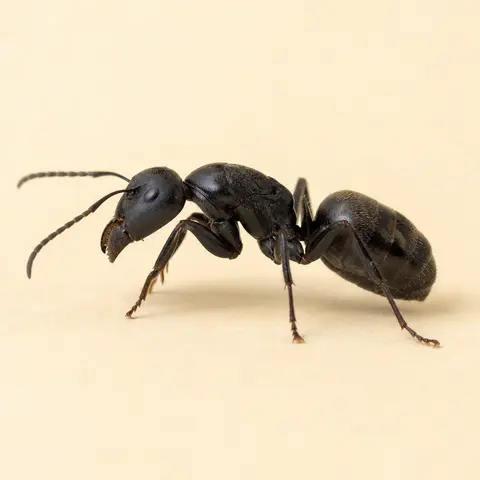
Carpenter ants carry a real premium — $250–$500, with $375 a fair midpoint — and the reasons are structural, not marketing. First, the colony lives inside wood: wall studs, sill plates, porch posts. Technicians drill small holes and inject dust or foam directly into the galleries, which is slower, more skilled work than spraying a baseboard. Second, carpenter ants nest in damp wood, so a competent job includes finding the moisture source — a roof leak, a sweating pipe, clogged gutters — because treated wood that stays wet gets re-colonized. Third, the work scales with the structure: Florida companies in our July 2026 survey priced carpenter ant treatment at $299–$800 billed by the linear foot, not as a flat visit. This Old House flags its own $200–$300 typical ant ticket as usually being carpenter ant work — which tells you how often that premium species is the reason anyone calls at all.
The termite-lookalike problem
Every spring, winged carpenter ants get mistaken for termite swarmers — in both directions, and both mistakes are expensive. The ID rules are mechanical: ant swarmers have elbowed antennae, pinched waists, and front wings longer than the back pair; termite swarmers have straight antennae, thick waists, and four wings of equal length. On the wood itself, carpenter ants excavate but do not eat it — they push out piles of clean, dry frass that looks like sawdust — while subterranean termites build mud tubes and leave soil in the damage. Get the call wrong one way and you pay $500–$2,000 for a termite liquid barrier you did not need; get it wrong the other way and a $250 ant treatment leaves termites eating the sill plates. The tiebreaker is cheap: termite inspections run $0–$150, average $100, and are often free when bundled with a treatment quote. Demand the written ID with the specimen before you accept either price.
Method pricing: why baits beat sprays for colonies
HomeGuide’s method breakdown is the most useful pricing table in the ant data: an exterior barrier spray runs $80–$120, individual mound treatments $100–$250, a bait program $120–$200, and a two-step colony elimination $600–$900. The cheap end is tempting and often wrong. The foragers you see on the counter are a small share of the colony, and a repellent spray kills only them — the queens keep laying. With budding species it is actively harmful: pharaoh ants respond to repellent chemicals by fracturing the colony into several new ones, each with its own queens. A spray that turns one colony into four is not a bargain at any price.
Baits work the opposite way. A slow-acting toxicant goes back to the nest through food sharing and reaches the queens in days to weeks. The trade-off is patience: the trail gets busier before it collapses, and wiping it down with cleaner defeats the $120–$200 you just spent. The two-step program — a non-repellent liquid barrier plus baiting — is the right tool for established multi-queen infestations, which is exactly the severe scenario HomeGuide prices at $800–$1,400 and up. It is the wrong tool as a default upsell for a first-time trail, so make the company justify the jump from $250 to $750 in writing.
Fire ants, for southern readers
Fire ant control is its own line item across the South, priced at $100–$300 per HomeGuide, and our Florida survey found yard treatments advertised at $95–$350. The per-mound math from the method table — $100–$250 per treatment — explains the trap: killing visible mounds is satisfying and temporary, because colonies from neighboring yards re-invade treated ground. A broadcast bait program over the whole yard costs more per visit but is the spend that actually holds, and in the fire ant belt it is the one recurring ant service that earns its schedule. If a company quotes per mound with no yard-wide option, ask for both numbers.
What Florida companies actually charge
Our survey of 588 Florida pest-company websites (July 2026) found published ant prices running $95–$800 — and the spread is the species ladder in action, not chaos. Fire ant yard treatments sat at the bottom at $95–$350, one Miami firm published a flat $225 for a general ant treatment — almost exactly the national average — and carpenter ant work topped the range at $299–$800 by the linear foot. Use the spread as a sanity check on any quote: a number over $500 needs the word “carpenter” or “severe” attached, with evidence, and a number under $150 is buying a mound treatment or a perimeter spray, not colony elimination.
One-time treatment or a pest plan
The honest decision rule: buy the visit for an incident, buy the plan for a pattern. A quarterly general plan at $100–$300 per visit, or monthly service at $40–$75, is a legitimate spend when ants re-invade every spring, when you are in fire ant territory, or when ants are one of several pests showing up. It is a bad spend when a $250 one-time treatment with a follow-up window would have closed the problem — which is the single sugar-ant-trail scenario the flag list above exists for. And if spiders are part of what you are seeing, read our spider exterminator cost guide before booking two separate services: spiders follow the insects they eat, and the visit that controls the ants usually does double duty for less than two stand-alone calls.
Ant extermination Cost Calculator
Pick your pest and home details — the estimate updates instantly. Same data as the tables on this site.
Your estimated cost
$100–$500 · avg $250
- Colony and trail identification
- Bait stations + barrier spray
- Nest treatment (direct if accessible)
- Follow-up if activity persists
- Moisture-source advice (carpenter ants)
Estimate for budgeting, not a quote — final pricing always follows an inspection.
Ant extermination cost by state
Prices below are our national range adjusted with state labor (BLS) and price-level (BEA) data — see how we calculate. Full state guides: all 50 states.
| State | Typical range | vs national |
|---|---|---|
| California | $110–$550 | + 10% |
| Texas | $95–$475 | -7% |
| Florida | $100–$500 | + 1% |
| New York | $110–$550 | + 12% |
| Pennsylvania | $100–$500 | -2% |
| Illinois | $100–$500 | + 1% |
| Ohio | $95–$475 | -6% |
| Georgia | $95–$475 | -6% |
| North Carolina | $95–$475 | -4% |
| Michigan | $100–$500 | -1% |