How Much Does Bee Removal Cost?
Quick answer
$125–$1,000 · avg $350
Professional bee removal costs $125–$1,000, and most jobs land near $350. A honey bee swarm resting in the open is often collected free by beekeepers, while an established colony inside a wall — comb extraction plus repair — is the four-figure tier.
| Treatment | Typical range | Average | Notes |
|---|---|---|---|
| Bee removal | $125–$1,000 | $350 | — |
| Swarm relocation (live) | $0–$350 | $150 | Beekeepers often collect honey bee swarms free |
Three prices, one insect
Bee removal has the widest honest spread in pest control — $125–$1,000 with a $350 average, per HomeAdvisor’s June 2026 and HomeGuide’s January 2026 guides — because “bee removal” describes three different jobs. HomeAdvisor’s own band is the narrow middle ($150–$500); HomeGuide stretches to $1,000 because its range includes structural work. Real Thumbtack jobs ran $141–$322 as of April 2026, which tells you most paid calls are the middle tier. Where your job lands comes down to one question: where are the bees, and is there comb yet?
Tier 1 — a swarm in the open: $0–$350, average $150. A swarm is a resting cluster — often football-sized — hanging from a branch, fence or eave while scout bees hunt for a permanent home. There is no comb, no honey and nothing to defend, which makes swarm bees about as docile as they ever get. Beekeepers often collect honey bee swarms for free, as Fixr’s 2025 guide notes — a healthy swarm has real value to them. The $0–$350 band with a $150 average covers the cases where a removal company drives out instead of a hobbyist with a box.
Tier 2 — an exposed hive: $125–$1,000, average $350. Once the colony has built comb — on a branch, under a soffit overhang, in a shed rafter — collection becomes cutting, boxing and hauling, and the free option disappears. Accessible hives sit near the $350 average; height, ladders and awkward access push toward the top. In our survey of 588 Florida pest-company websites (July 2026), almost nobody publishes a bee price; the exception, Dever in Miami, lists bee hive removal from $195 — right in line with the national floor for an accessible hive.
Tier 3 — an established colony inside a wall, soffit or chimney: the four-figure tier. This is a cut-out: open the structure, vacuum and box the bees, remove every piece of comb and honey, clean the cavity, seal the entrances, then repair the opening. The removal alone runs to the $1,000 end of the national range, and the repair line items stack on top. Read the next section before accepting any wall quote — this tier is where the worst shortcuts in the trade live.
The in-wall colony is a construction job
The four-figure tier is expensive for a mechanical reason, not a markup. An established colony is comb, brood and stored honey fastened to the inside of your wall, and all of it has to come out. Live bees fan the comb to keep it cool; kill or remove the bees and leave the comb, and the honey melts — through drywall seams, down stud bays, into ceilings — while the odor pulls in ants, roaches, wax moths and robber bees. Worse, the cavity stays scent-marked as prime real estate, so the next swarm moves into the same void and you pay for the job twice. That is why a legitimate wall job is removal plus comb extraction plus repair, never treatment alone.
The repair half deserves its own line items in the quote. Expect to see the access cut — drywall inside, or siding, soffit or brick outside — insulation replacement where honey soaked it, patching, texture and paint, and sealing of every entrance gap the colony used. Some removal companies carry the repair in-house; others cut, clean and leave the patching to your handyman. Neither model is wrong, but the quote must say which one you are buying, or the cheapest bid wins by quietly excluding half the project.
Why the pros refuse to exterminate honey bees
Call five pest companies about a honey bee colony and expect at least a couple to decline or refer you out. Part of it is regulatory — several states restrict when a licensed applicator may kill honey bees, generally requiring relocation where feasible — and part is the pollinator economics: honey bees are managed agricultural stock, and live relocation is the standard first attempt, listed by HomeGuide as the preferred method. But the self-interested reason matters most for your wallet. Extermination does not remove the comb, so the expensive problem is still inside the wall after the cheap treatment. A company quoting a kill-and-walk on honey bees is either inexperienced or betting you do not know what melted honey does to drywall.
The honest exception is aggression and access. In parts of the South, Africanized colonies can make live removal genuinely unsafe, and a colony deep in a chimney or block wall is sometimes beyond practical relocation. Even then the comb still has to come out — the method of handling the bees changes, the extraction and repair work does not.
Bees or yellowjackets? Look before you book
The most expensive mistake in this niche costs nothing to avoid: misidentifying yellowjackets as bees, or the reverse. A beekeeper will not touch yellowjackets. A general pest company treats a honey bee call as a referral. Either way, a wrong ID buys a wasted visit — service and inspection fees run $50–$200 per HomeGuide’s 2026 data — and you are still hosting the insects.
| What you see | Likely insect | Who to call |
|---|---|---|
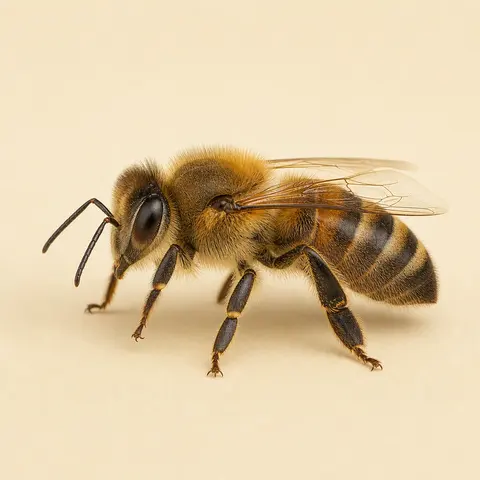
| Fuzzy, amber-brown body; calm, steady traffic to one entrance; wax comb if visible | Honey bees | Beekeeper or live-removal specialist |
| Smooth, bright yellow-and-black; fast, darting flight; traffic into a wall gap or ground hole, heaviest in late summer | Yellowjackets | Pest control company |
| Large, shiny black abdomen; hovering at deck rails or fascia with round drilled holes | Carpenter bees | Pest control company |
| Gray papery ball nest under an eave or in a tree | Wasps or hornets | Pest control company |
The price consequences are large. A yellowjacket nest inside a wall runs $600–$1,200 per HomeGuide’s January 2026 guide, and it is an extermination job with different math — covered in our wasp nest removal cost guide. Honey bees in the same wall are the removal-plus-comb-plus-repair project described above. Seasonality is the fastest tell: honey bee colonies fly year-round, while yellowjacket wall traffic explodes in late summer and dies at first frost.
What a fair quote includes — and the order to make calls
Work the tiers in order and the range stops being scary. A swarm in the open goes to the beekeeping association first — $0 beats the $150 average. An exposed hive goes to a live-removal company with the $350 average as your anchor and access driving the spread. A colony in the wall gets two itemized bids, each naming the comb extraction and the repair scope, because the four-figure tier is exactly where a vague quote costs the most. Every figure on this page traces to the 2026 national guides — HomeAdvisor, HomeGuide, Fixr and real Thumbtack job data — plus our own Florida survey; the methodology page shows how we source and weigh them.
Bee removal Cost Calculator
Pick your pest and home details — the estimate updates instantly. Same data as the tables on this site.
Your estimated cost
$125–$1,000 · avg $350
- Species ID (honey bees vs wasps)
- Live relocation attempt first (honey bees)
- Comb and hive removal from structure
- Repair scope for wall/soffit access
- Prevention sealing
Estimate for budgeting, not a quote — final pricing always follows an inspection.
Bee removal cost by state
Prices below are our national range adjusted with state labor (BLS) and price-level (BEA) data — see how we calculate. Full state guides: all 50 states.
| State | Typical range | vs national |
|---|---|---|
| California | $135–$1,100 | + 10% |
| Texas | $115–$925 | -7% |
| Florida | $125–$1,000 | + 1% |
| New York | $140–$1,100 | + 12% |
| Pennsylvania | $125–$975 | -2% |
| Illinois | $125–$1,000 | + 1% |
| Ohio | $120–$950 | -6% |
| Georgia | $120–$950 | -6% |
| North Carolina | $120–$950 | -4% |
| Michigan | $125–$1,000 | -1% |