How Much Does Wasp Nest Removal Cost?
Quick answer
$150–$700 · avg $400
Professional wasp or hornet nest removal costs $150–$700, and most jobs land near $400. Ground and in-wall yellowjacket nests are the expensive tier at $600–$1,200, while a small early-season paper wasp nest sits at the bottom of the range.
| Treatment | Typical range | Average | Notes |
|---|---|---|---|
| Nest removal | $150–$700 | $400 | — |
| Yellowjackets (ground/wall nest) | $600–$1,200 | $900 | — |
What actually moves the price
Nest removal is flat-rate work — home size barely matters, which is why the published guides agree so closely. Angi’s March 2026 guide and HomeGuide’s January 2026 guide both put a professional wasp or hornet nest job at $300–$700; Forbes shows a wider $100–$1,300 spread but calls a typical single nest about $300. Real completed Thumbtack visits ran $120–$286 as of April 2026 — the platform skews toward easy first-story paper wasp nests, which is exactly why its numbers sit below the published band. Put together, $150–$700 with a $400 average is the honest national picture. In our survey of 588 Florida pest-company websites (July 2026), the few companies that publish stinging-insect prices advertise from $195–$249 — right at the low-to-middle of that band for a standard accessible nest.
Three things decide where your job lands: the species (yellowjackets are a different tier entirely), the access (a ladder to a second-story eave is the single most common price multiplier), and the calendar (a June nest and a September colony are not the same job). Everything below is those three factors in detail.
Paper wasps, hornets, yellowjackets — three different jobs
Paper wasps build the open umbrella comb you see under eaves, deck rails and porch ceilings. Colonies stay small — dozens of wasps, not thousands — and the nest is exposed, so treatment and removal take minutes once the technician is standing in front of it. Reachable paper wasp nests are the bottom of the $150–$700 band, and they are most of what those $120–$286 Thumbtack tickets represent.
Hornets — usually bald-faced hornets — build the enclosed, football-shaped gray nests in trees and on upper-story walls. The colony is larger, the defense response is aggressive, and the nest is almost always high. Hornet jobs fill the top half of the $150–$700 band, and most of that premium is access, not chemistry: a nest at porch height and the identical nest at a 25-foot gable peak are priced very differently because one of them involves a technician on an extension ladder in a sting suit.
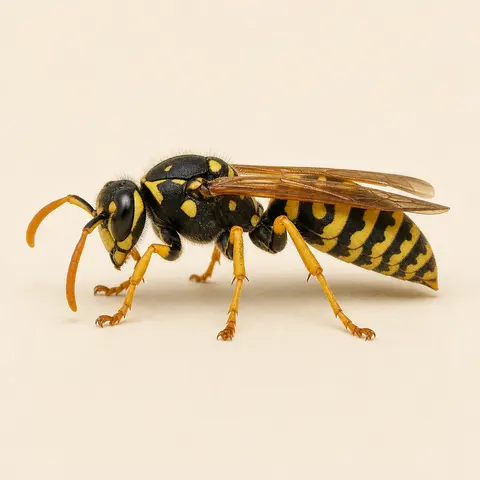
Yellowjackets are the tier the averages hide. They nest in the ground and inside wall voids, so there is nothing to knock down — the colony has to be located, treated at the entrance, and then physically extracted, which in a wall means opening the cavity and vacuuming out workers before cutting away comb. HomeGuide prices yellowjacket ground and wall nests at $600–$1,200, and a typical job runs around $900 — roughly triple a standard exposed nest. If a company quotes you $200 over the phone for “wasps in the wall,” they are either misdiagnosing the job or planning to spray the entrance and leave, which is the one outcome you should refuse — more on that next.
Why removal matters — the spray-and-leave problem
The cheap version of this service is a knockdown spray: kill the visible workers, leave the nest where it is. For an exposed paper wasp nest that is mostly fine. For anything inside a structure it is a false economy. A treated in-wall colony leaves behind comb packed with dead brood and larvae, and as it decomposes it draws the next wave of problems — carpet beetles, ants, flies, sometimes rodents — plus a smell you will not locate for weeks. That is why nest disposal is a line item in a proper quote, not an upsell.
The other structural mistake is sealing the entrance hole while the colony is alive. Trapped yellowjackets do not die quietly; they follow light and chew through interior drywall, and the call that started as an exterior job becomes wasps in the kitchen. A competent company treats first, confirms the colony is dead, removes what can be removed, and only then seals — if anyone proposes caulk on day one, get a second quote.
The June nest vs the September colony
Wasp colonies are annual. A queen starts alone in spring, the first workers appear in early summer, and the population peaks in late summer — for yellowjackets, several thousand workers by September. Price follows that curve. An early-season nest is a golf-ball-sized comb with a handful of slow wasps: fast, low-risk, bottom of the $150–$700 range. A September colony is the full job — maximum population, maximum defensiveness, full protective gear, and for yellowjackets the point in the year when in-wall extraction work is most likely. The single best money-saving move on this page is boring: treat the nest when you first see it, not after it has had a summer to grow.
The flip side is winter. After the first hard frosts the colony is dead — wasps do not overwinter in the nest, and old paper nests are not reused the next spring. A gray, silent January nest can be knocked down with a broom for free. Paying anything for it is questionable; paying a same-day emergency surcharge — nationally $50–$200, averaging $125 per HomeGuide — for a dormant nest is the clearest scam signal in this niche.
DIY honesty — and the three ER cases
Store wasp spray is one of the few pest products that does what the label promises. Used at dusk on a small, exposed paper wasp nest you can reach while standing on the ground, with a clear line of retreat, it ends the problem — no professional required, and no honest company will tell you otherwise.
The professional earns the $400 average in exactly three situations, and all three are ER math, not pest-control math. First, ladders: spraying overhead from an extension ladder means taking stings with nowhere to go, and the fall injures far more people than the venom. Second, yellowjacket ground and wall nests: step on the wrong patch of lawn with a mower, or poke a wall entrance, and the colony responds in the hundreds — these are the multi-sting incidents that end in emergency rooms. Third, allergy: if anyone in the household has had a serious sting reaction, no nest is a DIY nest, at any size. Against a possible anaphylaxis call, the $150–$700 professional band is cheap insurance.
After the nest: re-nesting and what comes next
Removal alone does not make the spot unattractive. Wasps do not reuse old nests, but new queens hunt the same sheltered eaves, soffit gaps and voids every spring, which is why a proper job ends with a residual treatment of the nest site and a warranty against same-season return — both should be in the quote you accept, not offered later as a callback fee. If you get stinging-insect pressure every single year, stop buying one-off removals: a general pest control plan — initial visit $125–$300, then $40–$75 monthly or $100–$300 per quarterly visit — has the technician treating eaves and entry points on schedule, and accessible nests are typically handled within the visit.
One identification caveat before you book anything: if the insects are fuzzy, slow, and working flowers, you likely have honey bees, and the economics invert — see our bee removal cost guide, where live relocation runs $125–$1,000 and a hanging swarm is often collected free by a beekeeper. Every figure on this page traces to the published 2026 guides and our own company-website survey, per our methodology.
Wasp & hornet nest removal Cost Calculator
Pick your pest and home details — the estimate updates instantly. Same data as the tables on this site.
Your estimated cost
$150–$700 · avg $400
- Nest location and species ID
- Protective-gear removal or treatment
- Nest disposal
- Re-nesting prevention treatment
- Warranty against same-season return
Estimate for budgeting, not a quote — final pricing always follows an inspection.
Wasp & hornet nest removal cost by state
Prices below are our national range adjusted with state labor (BLS) and price-level (BEA) data — see how we calculate. Full state guides: all 50 states.
| State | Typical range | vs national |
|---|---|---|
| California | $165–$775 | + 10% |
| Texas | $140–$650 | -7% |
| Florida | $150–$700 | + 1% |
| New York | $165–$775 | + 12% |
| Pennsylvania | $145–$700 | -2% |
| Illinois | $150–$700 | + 1% |
| Ohio | $140–$650 | -6% |
| Georgia | $140–$650 | -6% |
| North Carolina | $145–$675 | -4% |
| Michigan | $150–$700 | -1% |